
Divorce in Nepal refers to the legal termination of marriage through a judicial process. The divorce process in Nepal is governed by the National Civil Code, 2017 (Muluki Civil Code, 2074), which provides procedures for both mutual consent divorce in Nepal and contested divorce in Nepal. Either spouse may file a divorce case in Nepal before the competent District Court having jurisdiction over the matter.
Mutual Consent Divorce Process in Nepal:
A mutual consent divorce in Nepal is the fastest and simplest method of dissolving a marriage where both husband and wife voluntarily agree to separate and settle issues relating to property, alimony, and child custody.
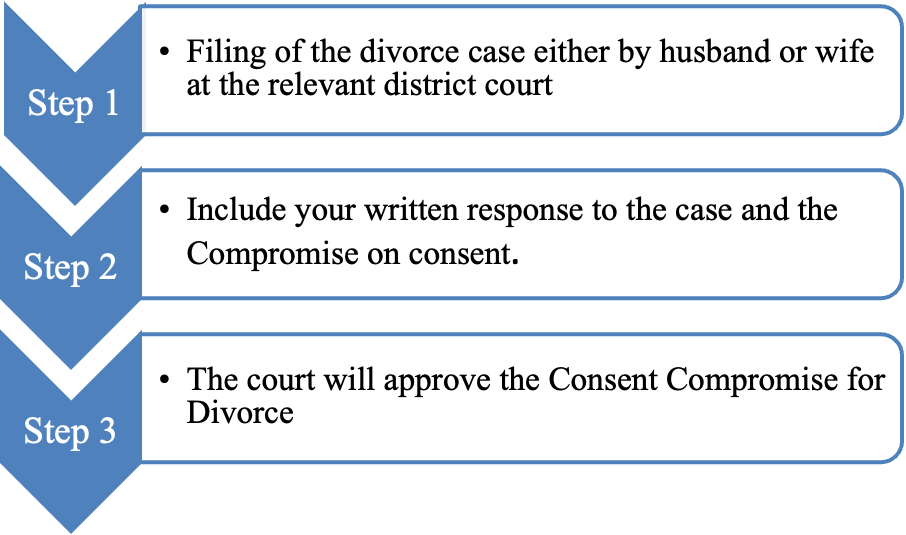
Divorce time period: The period for completing the process of divorce will be between two to three days.
Documents Required for Divorce in Nepal:
| S.No. | Documents |
| 1 | Copy of citizenship of husband and wife |
| 2 | Copy of marriage registration certificate (otherwise copies of marriage photographs or birth certificates of children or any other proof) |
| 3 | Copy of birth certificate of children under 16 years of age or their citizenship |
| 4 | Two copies of passport size photographs of husband and wife |
Legal Grounds for Divorce in Nepal Under the Muluki Civil Code 2074:
A husband may file for divorce on any of the following grounds:
- The wife has lived separately for three consecutive years without his consent.
- The wife deprives him of maintenance or expels him from the home.
- The wife causes or conspires to cause grievous physical or mental harm.
- The wife is proven to have sexual relations with another person.
A wife may file for divorce on any of the following grounds:
- The husband lived separately for three consecutive years without her consent.
- The husband deprives her of maintenance or expels her from the home.
- The husband inflicts or conspires to inflict grievous physical or mental harm.
- The husband contracts another marriage.
- The husband commits adultery.
- The husband rapes or conspires to rape the wife.
Contested Divorce:
A contested divorce in Nepal arises when one spouse does not consent to the divorce or disputes issues relating to property division, child custody, or alimony. In such circumstances, the divorce procedure in Nepal requires formal court proceedings and judicial determination of the dispute.
General Procedure
The contested divorce process generally involves the following steps:
- Filing of divorce petition at the District Court.
- Issuance of notice to the other spouse.
- Submission of written defense or reply by the respondent spouse.
- Mandatory mediation and reconciliation efforts.
- Court hearings, evidence submission, and witness examination.
- Issuance of temporary orders relating to maintenance, custody, or alimony, where necessary.
- Final judgment and divorce decree by the court.
- Registration of divorce and cancellation of marriage records at the concerned Ward Office.
Contested divorce cases generally take 8–12 months or more, depending on the complexity of the case and the circumstances involved.
Child Custody After Divorce in Nepal:
One of the most important issues following a divorce in Nepal is determining child custodyafter divorce. Nepali courts apply the best interest of the child principle when deciding custody disputes and parenting arrangements.
The custody of children after divorce in Nepal comes under the Muluki Civil Code 2074 and gives preference to the “best interest of the child” rule. Courts consider parental suitability, economic stability, and affection while considering provisions made specifically for minors under different age groups.
Court filling procedure for child custody in Nepal:
| Steps | Process |
| Step 1 | Jurisdiction and administration |
| Step 2 | Petition preparation |
| Step 3 | Filling and notice |
| Step 4 | Mediation |
| Step 5 | Hearing and evidence |
| Step 6 | Judgment |
Documents Required for Child Custody Cases in Nepal:
Original documents plus 3 certified copies must be submitted:
- Citizenship Certificate
- Child’s Birth Certificate
- Marriage/Divorce Certificate
- Income Verification
- Property Documents
- Character Certificate
- Medical Records
- Communication Logs
Property Division and Partition Share After Divorce in Nepal:
When Can a Husband Refuse Partition Share or Alimony in Nepal?
The husband will not be compelled by law to provide partition share or alimony to his wife in the following cases:
- Where the wife makes the husband liable to the cost of maintenance or drives him out of the house.
- In cases where there is any act or conspiracy to do any grievous hurt or causing severe pain to the body or mind of the husband.
- In cases where the wife is guilty of having carnal intercourse with any other man.
Alimony and Maintenance Rights After Divorce in Nepal:
Where the wife who dissolves the marriage seeks a lump sum amount from the husband instead of the share of property or alimony annually or monthly, then the court may compel the husband to give the wife a lump sum amount annually or monthly depending upon the property of the husband.
However, if the wife who dissolves her marriage remarries another man, it will not be necessary to provide this amount or alimony to her.
Conditions Under Which Child or Former Husband can Claim Possession of Property
In case of the demise of a divorced lady, her child or children, if there are any, would have the right to inherit her property. In case there are no children, then her former husband shall inherit the property given to her by him, while her heir through her maternal lineage will be the one who inherits the property which was not bequeathed by the husband.
Women’s Property Rights and Partition Share After Divorce in Nepal
The wife gets equal share of partition in the property of her husband. The following people shall be considered coparceners when it comes to division of common property between them: Husband, Wife, Father, Mother, Son, Daughter.
Where a common property is jointly registered under the names of either the husband or wife, then the property should be equally divided between both prior to divorce proceedings.
If it turns out that even the husband himself has not gotten any partition of property from his father or other coparceners, then the Court will partition the common property between both based on inquiries of coparceners’ rights for division.
Conclusion:
Whether you are seeking a mutual consent divorce or a contested divorce in Nepal, understanding your legal rights is essential. Prime Law Associates provides trusted legal assistance in divorce, child custody, alimony, and property division matters across Nepal.
Divorce FAQs in Nepal
1.How much time does divorce take in Nepal?
Ans: Mutual divorce normally takes 2-3 days, while divorce by contest can take 8-12 months or even longer.
2.What documents are needed for divorce in Nepal?
Ans: Documents that are usually necessary include citizenship certificate, marriage certificate, birth certificate of children, and passport-size photo.
3.Is it possible for a wife to claim property after divorce in Nepal?
Ans: Yes, subject to the provisions relating to partition share and property rights under the National Civil Code.
4.Who will get custody of the child after divorce in Nepal?
Ans: Child custody is awarded depending on the welfare of the child according to the court’s decision.
5.Is it possible to claim alimony after divorce in Nepal?
Ans: Yes, it depends on the circumstances as well as the economic position of the couple.